
At 2 a.m., healthcare and nursing services may be waiting for a computer application to load. Or an individual may have failed to activate a security function, and so a patient file is left accessible. Employing people for a hospital tech department is therefore highly significant.
As mentioned above, it is a unique environment. In this section, I will discuss who should be employed, how best to source people, and common issues that can arise.
Why Healthcare Tech Hiring Is Different
HIPAA is relevant within healthcare, although it is not generally covered by most technology roles.
- Knowledge of healthcare is required. People must understand both healthcare processes and data flow.
- People must also know how to respond to issues that may occur at 3 a.m., for example.
- Basic competencies. Interoperability, security, and system availability are key areas that define the role.
- Compliance is fundamental. Regulations such as the HIPAA Security Rule dictate a basic level of data security, and therefore all people recruited must place importance on this area.
Roles You’ll Probably Need
Every team’s a little different, but most healthcare tech professionals land in a handful of broad groups:
- EHR analysts and Epic or Cerner specialists
- Cybersecurity and compliance staff
- Data and analytics engineers
- Cloud and infrastructure engineers
- Integration and interoperability developers
- Help desk and clinical support
Security people are the hardest to land. Demand for security analysts is projected to grow much faster than average, so you’re basically up against banks and big tech.
Where Healthcare Tech Staffing Services Fit In
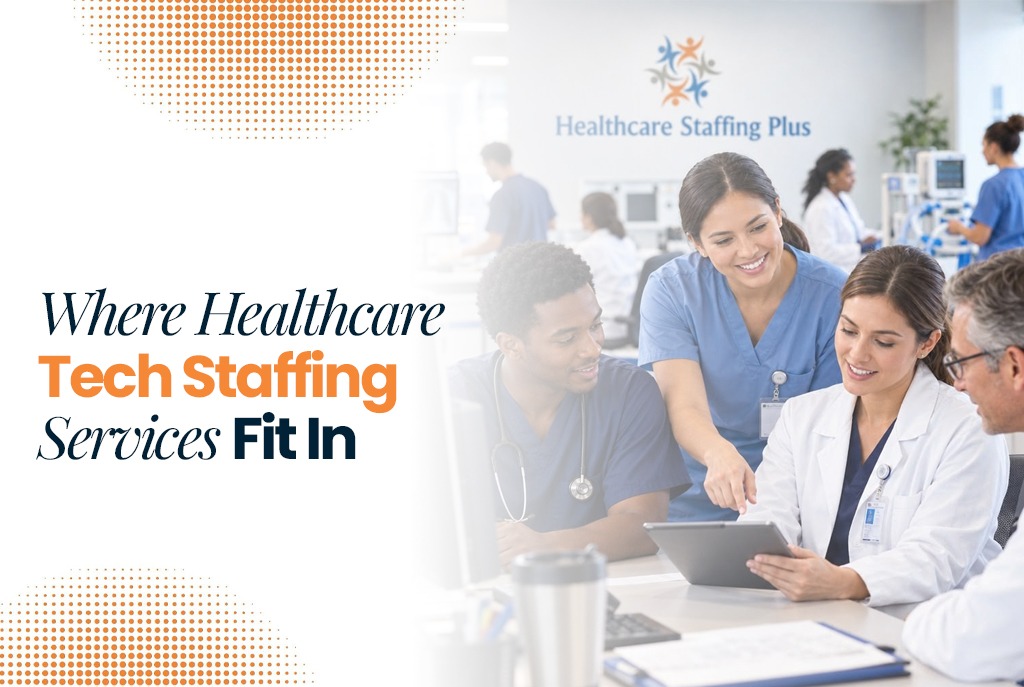
Many hospital trusts attempt to source all their staff. But this can take many months. Healthcare technology staffing companies can supply already selected staff with knowledge of health tech. This is highly beneficial for go-lives and for system enhancements.
Plus it is effective if you require someone for only 6 months – rather than 6 years. Find out about their selection process.
As well as being used for interim roles, healthcare staffing services is also utilised widely to accelerate the appointment of permanent staff.
Healthcare Tech Recruitment Steps That Work
Good healthcare tech recruitment starts well before you post the job.
- Understand what is required – development, maintenance or enhancement?
- Use clear, unambiguous wording in job descriptions and identify the technology that will be used.
- Assess suitability for the clinical environment as well as technical ability.
- Interview promptly as good people do not tend to hang around.
- Where possible, contact referees in other health-related organisations.
Where to Find Healthcare Tech Professionals
Job boards help, but the best healthcare tech professionals usually have jobs already and aren’t searching. Try these routes:
- Referrals from your current team
- Health tech groups and local meetups
- Hospital alumni networks
- Staffing partners who know healthcare
- Contractors you can convert to full-time
A Rough Hiring Timeline
Generally, the recruitment process follows this structure:
- Week 1 – establish specification and budget.
- Weeks 2-3 – advertising and shortlisting.
- Weeks 4-5 – interviewing and checking references.
- Week 6 – making and negotiating an offer.
- Weeks 7-10 – induction and the period of notice.
This is therefore a two and a half month process. A recruitment partner may be able to reduce the time taken in the initial weeks but allow for some contingency.
Skills That Matter Most
- Skills in EHR, cloud and/or security
- Knowledge of HIPAA and patient confidentiality
- Good interpersonal skills, both with nurses and medical staff
- Composure in a systems failure
- Commitment to furthering your skills
Whilst focusing on technical expertise, don’t underestimate good interpersonal skills. An amazing engineer is of no use if they are unable to communicate how they have resolved an issue to a charge nurse.
Build a Team That Lasts
- Healthcare technology recruitment is useful. A contract-to-hire allows a suitable match to be identified.
- As well as recruitment, you must also consider staff retention.
- Induct people. Provide a structured induction and allocate mentors who understand your systems.
- Provide progression routes. Demonstrate how people can progress in their careers.
- Equip people. As well as being up-to-date, technology is key. Cross-system integration is a particularly good area, as engineers enjoy working on this and it can enhance healthcare provision.
- Healthcare technology recruitment is useful. Again, a contract-to-hire allows a suitable match to be identified.
Common Hiring Mistakes
- Specialisation in technology areas and not health
- Slow recruitment processes and candidate attrition
- Poor rates of pay for security and data positions
- Failure to check people’s background and qualifications.
- Lack of succession planning.
Generally speaking, these problems link back to both speed and suitability. If these can be managed well, then recruitment can be much smoother.
Key Takeaways
- There is a need for a combination of technological and medical knowledge in healthcare roles.
- Technology in healthcare can also be used to help meet temporary needs.
- In the healthcare industry, technology recruitment is done efficiently and effectively.
- Understanding of security and compliance is a must.
- Similarly, it is crucial to retain employees.
- Take into account a project timetable and grant time extensions.
Frequently Asked Questions
What is healthcare technology recruitment?
It can enable more rapid recruitment and can also support temporary and non-scrolling workforce requirements.
How long does healthcare technology recruitment take?
This varies. Even for niche roles, it can often take a couple of months. Recruitment partners can at times help to accelerate this process.
What should I pay healthcare technology experts?
Look at current sector pay scales for the required role. For example, in 2025, the median salary for security analysts was in excess of $129,000. So, ensure you are paying appropriately.
Is contract or permanent staff better?
Neither option is universally preferable. Temporary staff is well suited to supporting temporary work. Permanent staff are ideal for sustained work. And there is also a hybrid option known as contract-to-hire.
Can small practices access digital expertise?
Of course they can. Temporary or contract staff are an excellent way of accessing expert digital knowledge and are especially good value for smaller practices.
Conclusion
Kupplin is a healthcare recruitment business as well as providing nurses, allied and management staff; we are also able to provide and advise on recruitment for those wishing to build up their digital capability.
Are you looking to recruit again? We can assist in identifying what to do. An excellent digital health function is not developed by chance. Good structure, fast recruitment, and individuals passionate about patient care are key.
Need the right talent for your team?
Partner with Kupplin to access data-driven recruitment solutions that connect you with skilled professionals quickly and efficiently.
Book a Free Consultation
