
Over 65% of hospitals are running below capacity due to staffing gaps. That means nurses juggling nine patients, call lights ringing for eleven minutes, and families begging for updates in hallways. Nobody planned this.
Additionally, when there aren’t enough staff members on the floor, patients often feel it. And sometimes they pay for it in ways you can’t undo.
This isn’t a new problem. It’s just getting harder to ignore.
Nursing shortages have been building for years. Now, it’s everywhere. Over two-thirds of hospitals have had to cut back because of staffing gaps. That used to be the exception.
Now, for many, it’s just become a part of their daily routines.
Hospital Understaffing Effects on Patients
When one nurse staffing covers eight or nine patients instead of four or five, it impacts everyone around, especially the patients.
- First, the small stuff: vitals get delayed,
- Then wound care waits.
- Then the medicine timing slips.
- Then patient education becomes a rushed two-minute talk at discharge.
Nothing extremely dramatic, just a slow erosion.
The data is consistent; the lower the proportion of professional nursing staff on a unit, the higher the rates of medication errors and wound infections. Not only this, but the staffing levels falling below target thresholds have also been directly linked to increased patient mortality.
Staffing Impact on Patient Outcomes And The Disappearance of Care
Here’s the part that rarely makes it into official incident data. More than 75% of nurses report omitting some form of care during their shifts, delayed wound care, missed medication doses, and reduced patient monitoring, all of it is tied to inadequate staffing levels.
These aren’t nurses cutting corners. They’re nurses doing triage on their own time and attention because the math simply doesn’t work. The staffing impact on patient outcomes from these smaller omissions rarely shows up in any single incident report. It shows up in readmission rates. In patient satisfaction scores. In the family that never came back to that hospital.
The Cycle That Keeps Making It Worse
When you’re short on staff, the harm doesn’t stop with patients in that moment. It triggers a domino effect that just keeps making everything harder to turn around.
Burnout Is Driving People Out the Door
It’s a cycle. Nurses get overworked, and they burn out. Then they leave. One nurse leaves, and everyone left has to do more, so more nurses burn out. 55% of healthcare workers are already looking for a new job or are about to start. And 84% feel like their employer doesn’t value them.
Those aren’t numbers from a workforce that’s about to get stable.
The Financial Hit Is Bigger Than Most Facilities Admit
Replacing one nurse costs $40,000 to $60,000. Do that across a whole hospital, and it dwarfs what retention programs would cost. Hospital understaffing effects aren’t just agency fees, it’s recruiting, overtime, lost productivity, and slow ramp-ups.
Treat it like a short-term problem? You just keep paying the same price on repeat.
Nurse Staffing Solutions That Fix The Problem
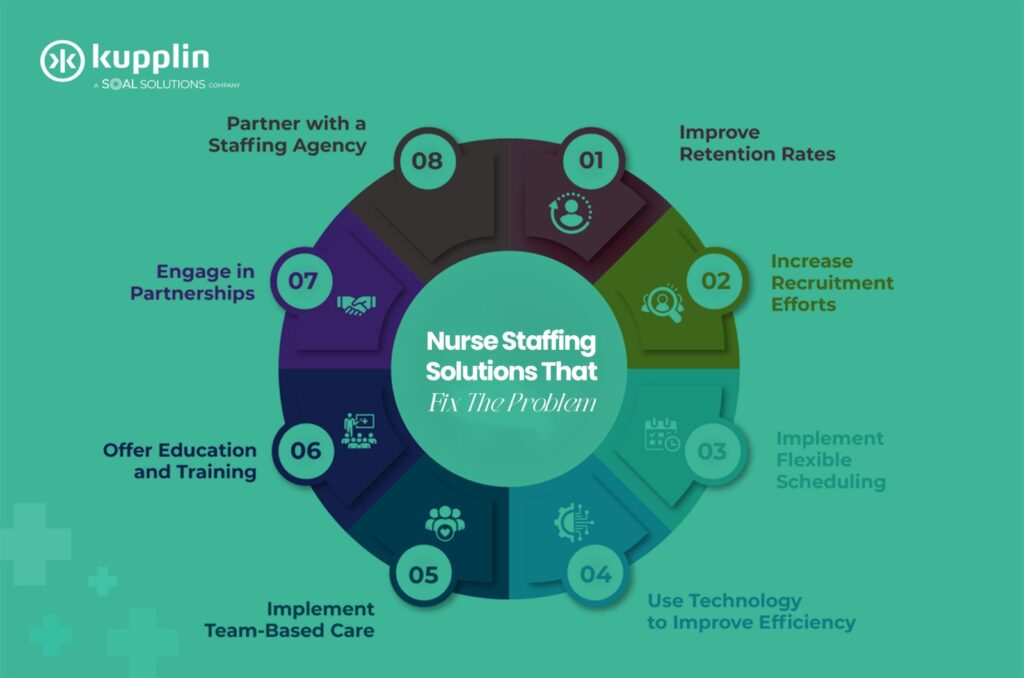
The ones navigating healthcare staffing shortages without constantly falling into crisis mode aren’t doing anything revolutionary. They just stopped treating preparation as optional. Here are a few things the smart facilities do.
They Build Their Bench Before They Need It
Waiting until a shift goes uncovered to start looking for help is the most expensive version of this problem. More health systems are developing internal flexible staffing pools made up of:
- pre-credentialed clinicians,
- part-time workers,
- retirees, and
- people seeking non-traditional schedules.
These are the people who can be deployed based on real-time demand. That means when a surge hits or someone calls out, the answer isn’t a last-minute agency call. It’s a list of people who already know what’s expected of them.
They Take Retention Seriously as a Business Strategy
Not as an HR initiative. Not as a wellness program. As an actual financial strategy.
Facilities seeing real retention improvements are building backup coverage into their scheduling structure, keeping overtime in check, and rotating demanding shifts fairly. The stability is showing up in their workforce numbers. Nurses don’t leave jobs that feel manageable. They leave jobs that don’t.
They Work With a Staffing Partner Who’s Already Done the Legwork
Decent staffing solutions aren’t built in a crisis. A real partner keeps qualified people ready before you ever call. So when a gap opens, you’re choosing from professional candidates, not scrambling for a warm body.
Treat staffing as a priority, not a reaction; that’s what separates facilities that survive from ones that get buried. Healthcare staffing partners like Kupplin are the ones that you are looking for to protect you from these crises.
FAQs
Is the link between staffing shortages and patient safety actually that direct?
It really is. When ratios go past safe levels, errors go up, complications get missed, and patients leave confused. The research on this is decades deep, and it doesn’t change much by facility type or location.
Where should a facility start when trying to build better nurse staffing solutions?
Start with your own people. Replacing a nurse costs more than keeping one. Flexible schedules, fair shifts, and actually listening go a long way. An ideal staffing partner just fills the gaps you can’t cover.
What makes Kupplin different when it comes to healthcare staffing shortages?
We don’t wait for a crisis and just throw anyone at you. We get to know you first, keep a bench of qualified pros ready, and already know what fits when you need help. Reach out to Kupplin. Let’s figure it out.
Conclusion
The staffing impact on patient outcomes doesn’t announce itself dramatically. It accumulates quietly, in the care that got delayed, the instruction that didn’t land, the nurse who hit a wall and handed in their notice. Hospital understaffing effects compound over time, and by the time they’re obvious, they’re already expensive.
The facilities that break this cycle aren’t waiting for better conditions. They’re building their pipelines early, investing in the people already on their team, and partnering with someone who understands what healthcare staffing actually looks like from the inside.
At Kupplin, that’s the work we do. If your facility is already feeling it, or you want to get ahead of it before the next surge, reach out and let’s talk about what you actually need.
Need the right talent for your team?
Partner with Kupplin to access data-driven recruitment solutions that connect you with skilled professionals quickly and efficiently.
Book a Free Consultation
