
Allied health professionals make up more than 60% of the entire U.S. healthcare workforce. Most facilities do not realize how dependent they are on that workforce until a lab tech, radiographer, or respiratory therapist gives notice and there is no one behind them.
The shortage is not coming. It is already here, and it is getting worse before it gets better.
The Allied Healthcare Staffing Shortage Is Already Here
By 2026, the U.S. will be short over 3.2 million allied healthcare workers, lab techs, physical therapists, radiographers, and more.
The numbers are steeper than most realize. Medical lab techs have a 23.8% vacancy rate. Respiratory therapists sit at 22.6%. These roles don’t get the attention nursing shortages do, but when a lab slows down, or a respiratory shift goes uncovered, every department that depends on them feels it.
Where the Pressure is Building Fastest:
- Radiologic technologists and clinical lab techs: 17% to 29% short in high-demand metros
- Physical and respiratory therapists: among the largest projected federal shortages through 2038
- Medical technologists and imaging staff: retiring faster than schools can replace them
- Entry-level allied roles: growing demand from aging patients, not enough new grads entering the field
What an Unfilled Allied Health Role Actually Costs
Most facilities track agency fees and job board costs. But that’s only part of the picture.
When an allied health role sits open, the work doesn’t stop. Someone covers it, usually through overtime or expensive temp staff, often costing more than the role itself would have.
- Industry average cost-per-hire: around $4,700, but can hit $10,000+ for specialized roles
- Replacing a permanent allied health worker: $20,000 to $50,000 after recruiting, training, and lost productivity
- And that’s assuming everything goes right. It usually doesn’t.
Turnover just makes it worse. Healthcare turnover runs above 20% in some facilities. Every departure restarts the cycle, and the team left behind gets stretched even thinner.
Why Allied Health Staffing Shortages Are Uniquely Challenging
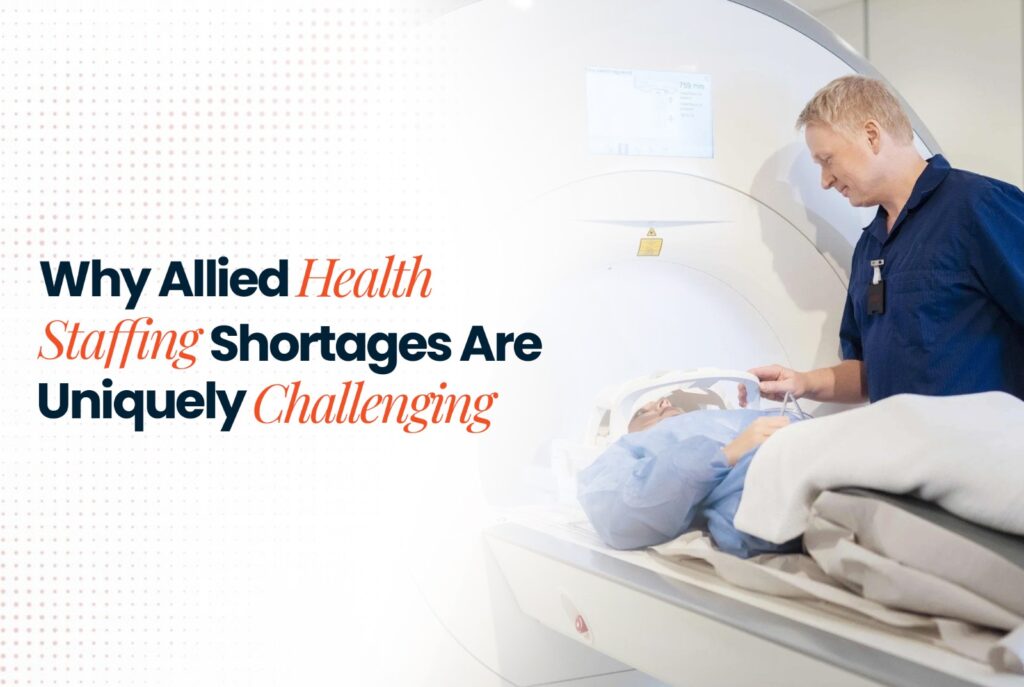
Allied health hiring isn’t about volume. It’s about getting the right fit, and that makes it uniquely challenging.
- Licensure, credentialing, and facility-specific onboarding add weeks, even after a candidate is chosen
- You can’t swap a radiographer for a lab tech like a generalist role
- The skill match has to be exact, and paperwork must clear before they step on the floor
That’s why time-to-fill often stretches past 49 days, and some roles take even longer. Every extra day means the existing team carries the load.
Building a Reliable Allied Healthcare Staffing Agency Partnership
Reactive hiring is the default for most facilities, and it is the most expensive way to solve this problem.
An allied healthcare staffing agency with existing candidate pipelines changes the math. Instead of starting a search cold when a role opens, the facility is drawing from professionals who are already vetted, already credentialed, or close to it.
A few things separate a staffing partnership that actually holds up from one that does not:
- Pre-vetted candidate pools specific to allied health, not general healthcare staffing
- Credentialing and licensing compliance handled before the candidate reaches your floor
- A blend of contract, travel, and permanent placement options so a single vacancy does not become a six-month search
- Familiarity with the specific technology and equipment your department runs, not just the job title
Facilities that build this relationship before a vacancy opens are not reacting. They are calling a partner who already has candidates in motion.
How to Retain the Allied Health Professionals You Already Have
New hires won’t solve the problem if current staff keep leaving. Retention has to come first.
- Listen to staff directly; don’t assume what they need. That surfaces the changes that actually reduce turnover.
- Schedule flexibility goes a long way. Longer shifts with fewer days, or shorter shifts with more, both work, depending on the team.
- Combine that with clear communication and involved management, and allied health teams hold together much better under pressure than headcount alone would suggest.
Frequently Asked Questions
Q1: How big is the allied healthcare shortage?
The U.S. will be short over 3.2 million allied health workers. Lab tech and respiratory therapist vacancy rates are already above 20%. Allied health makes up over 60% of the workforce, so gaps ripple everywhere.
Q2: What does an unfilled allied health role cost?
Beyond agency fees, overtime and per diem costs add up. Replacement runs $20,000 to $50,000 when recruiting and lost productivity are included. Facilities tracking only job board spend are missing most of the real cost.
Q3: How does Kupplin help with allied staffing?
Kupplin keeps active pipelines for lab techs, radiographers, and respiratory therapists, pre-vetted and credential-ready. Contract, perm, or contract-to-hire. Reach out and let’s show you what a stable allied workforce looks like.
Key Takeaways
- The U.S. faces a shortfall of more than 3.2 million allied healthcare workers, with some role vacancy rates already above 20%
- Allied health professionals make up over 60% of the healthcare workforce, so shortages here affect every department
- Replacing a permanent allied health professional can cost $20,000 to $50,000 once recruiting and lost productivity are counted
- Credentialing and licensing requirements make allied health roles slower to fill than most other hiring categories
- Retention and staffing partnerships both matter. One without the other leaves the gap open
Conclusion
Allied health recruitment done well is not a reaction to a vacancy. It is a relationship that exists before the vacancy happens.
The facilities holding their allied health teams together through this shortage are not the ones posting fastest when someone quits. They are the ones who already have a partner with the right candidates in motion and a retention strategy that keeps the team they have.
Kupplin helps healthcare facilities build allied healthcare staffing that holds up under pressure, not just fills a seat. Reach out to the Kupplin team and let us build the pipeline before you need it.
Need the right talent for your team?
Partner with Kupplin to access data-driven recruitment solutions that connect you with skilled professionals quickly and efficiently.
Book a Free Consultation
