
When unmanaged overtime hits 10% of total hours worked, it costs a 300-bed hospital an estimated $3 million annually. And that is just one line item.
Agency dependency, premium shift rates, invoice errors, and the churn of replacing nurses who burnt out months ago- healthcare facilities are bleeding money through gaps in their staffing infrastructure that most leadership teams are only addressing after the financial damage is already done.
The good news is that cutting healthcare staffing services costs does not mean cutting corners on care. It means building systems that reduce dependence on expensive agency labor by getting better at using the resources already in-house.
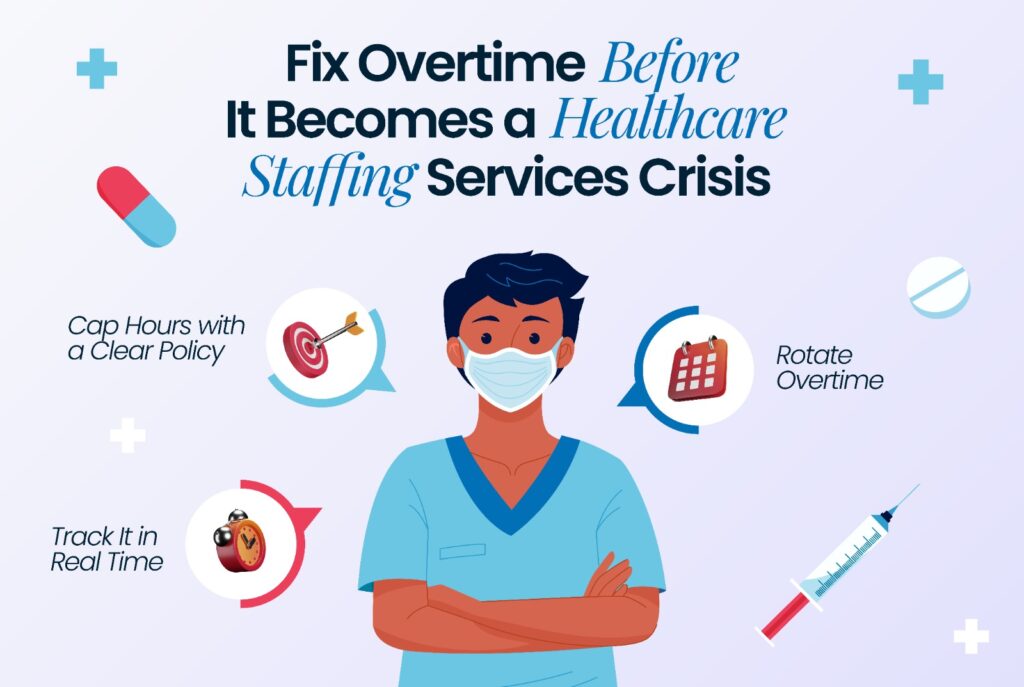
Fix Overtime Before It Becomes a Healthcare Staffing Services Crisis
Overtime is the most immediate lever most facilities aren’t pulling hard enough.
At a 300-bed hospital, overtime at 10% of total hours costs about $3 million a year. Cutting it to 2.5% saves roughly $1.2 million. That’s not theory; it’s documented.
Three things make it work:
Track It in Real Time
Flags when someone’s nearing their hourly limit let managers shift coverage before overtime kicks in.
Cap Hours with a Clear Policy
Verbal agreements don’t hold up. A documented policy changes behavior.
Rotate Overtime.
Same nurses picking up extra shifts every cycle leads to burnout. Spread the load.
Use Internal Nursing Staffing Resources Before Calling the Agency
This one’s obvious, but the execution is where it falls apart.
34% of care facilities say they spend half their day on staffing admin, calling, texting, and emailing internal staff one by one. By the time that’s done, the shift is still open, and the easiest move is to call an agency.
Facilities that reach all internal staff at once, through a system instead of manual outreach, cut agency calls significantly before the shift even needs filling. The savings add up fast. When bank staff takes shifts that would’ve gone to agencies at premium rates, the per-shift cost drops.
The principle is simple: internal first, bank second, agency last. Not the default.
Control the Rates You Pay for Nursing Staffing and Allied Healthcare Staffing
Most facilities juggle multiple agencies with different rates for the same staff, and managers filling a 6 am gap have no idea what those rates are.
So shifts get filled at whatever the first agency quotes, not the best rate. That’s an unnecessary premium every month.
- Tier your agencies. Tier 1 gets first crack, cheapest and still meets quality.
- Tier 2 only if Tier 1 can’t fill.
- Tier 3 last resort. The shift still gets covered, just at the lowest viable rate.
For nursing and allied healthcare staffing alike, rate visibility and tiered access cut costs fastest without touching quality.
Improve Retention to Reduce Healthcare Recruitment Costs
The Upstream Fix
- Takes longer to show on a spreadsheet, but addresses the root cause
- Training a new employee: ~$954 (more for clinical roles with licensing and onboarding)
- Every departure replaced by agency staff compounds costs in multiple directions
What Actually Retains Staff
- Flexible scheduling with some control over hours
- Real career development pathways
- A culture that acknowledges burnout instead of normalizing it
- Feedback loops that lead to visible change
The Patient Safety Case
- Team-training organizations see:
- 15% fewer patient deaths
- 19% fewer medical errors
- Lower turnover
Retention isn’t just cost savings; it’s patient safety
Protect Healthcare Staffing Services From Invoice Fraud and Billing Errors
This is the cost reduction nobody talks about because it’s uncomfortable.
Some agencies bill for shifts that were never worked, hiding them in high-volume invoices where manual review isn’t realistic. Without consolidated invoice management and timesheet verification, facilities pay for shifts that never happened.
Consolidating agency billing into one verified structure and requiring proof of shift completion before payment removes that exposure completely. It also cuts the admin time spent reconciling multiple invoices every cycle.
Frequently Asked Questions
Q1: Fastest way to reduce agency dependency?
Fix internal outreach first. Most facilities use agencies not because internal staff is unavailable, but because reaching them is harder than one agency call. Systems that contact all available staff at once fill shifts internally before agencies are ever needed.
Q2: How does overtime reduction affect nursing staffing costs?
Directly. A 300-bed hospital cutting overtime from 10% to 2.5% saves ~$1.2 million a year. Real-time tracking, hourly caps, and rotating overtime prevent burnout. Every departure restarts the replacement cycle, making retention the most cost-efficient strategy.
Q3: How does Kupplin help reduce agency costs without compromising care?
We keep pre-vetted pipelines for nursing and allied staffing so gaps get filled fast, without last-minute premium agency calls. Immediate or long-term, reach out and let’s figure out where you can actually reduce agency spend.
Key Takeaways
- Unmanaged overtime at 10% of total hours costs a 300-bed hospital $3 million annually; reducing it to 2.5% saves $1.2 million
- 34% of care facilities spend half their day on manual staffing admin because they are contacting internal staff one at a time instead of simultaneously
- Tiering agencies by rate and quality standard ensures every shift is filled at the most cost-effective available option rather than whoever responds first
- Each 1% improvement in nurse retention reduces replacement, agency, and training costs that compound across every departure
- Invoice fraud and billing errors are a documented cost leak in high-agency environments and require systematic verification to address
Conclusion
Healthcare staffing services costs do not come down by cutting what gets spent on individual shifts. They come down by reducing how many premium shifts are needed in the first place.
Nursing staffing and allied healthcare staffing costs are highest when facilities are reactive. When agency calls happen because internal outreach failed, when overtime spikes because nobody caught it in time, when nurses leave because the conditions were unsustainable and nobody addressed it until the exit interview.
Healthcare recruitment built around retention, internal staff utilization, and rate control does not compromise patient care. It produces more consistent care by putting stable, familiar staff on the floor instead of agency workers who have never seen the unit layout.
Kupplin helps healthcare facilities build the staffing foundation that makes reactive agency dependency the exception rather than the norm. Reach out to the Kupplin team and let us figure out where your facility’s staffing costs can actually start coming down.
Need the right talent for your team?
Partner with Kupplin to access data-driven recruitment solutions that connect you with skilled professionals quickly and efficiently.
Book a Free Consultation
